
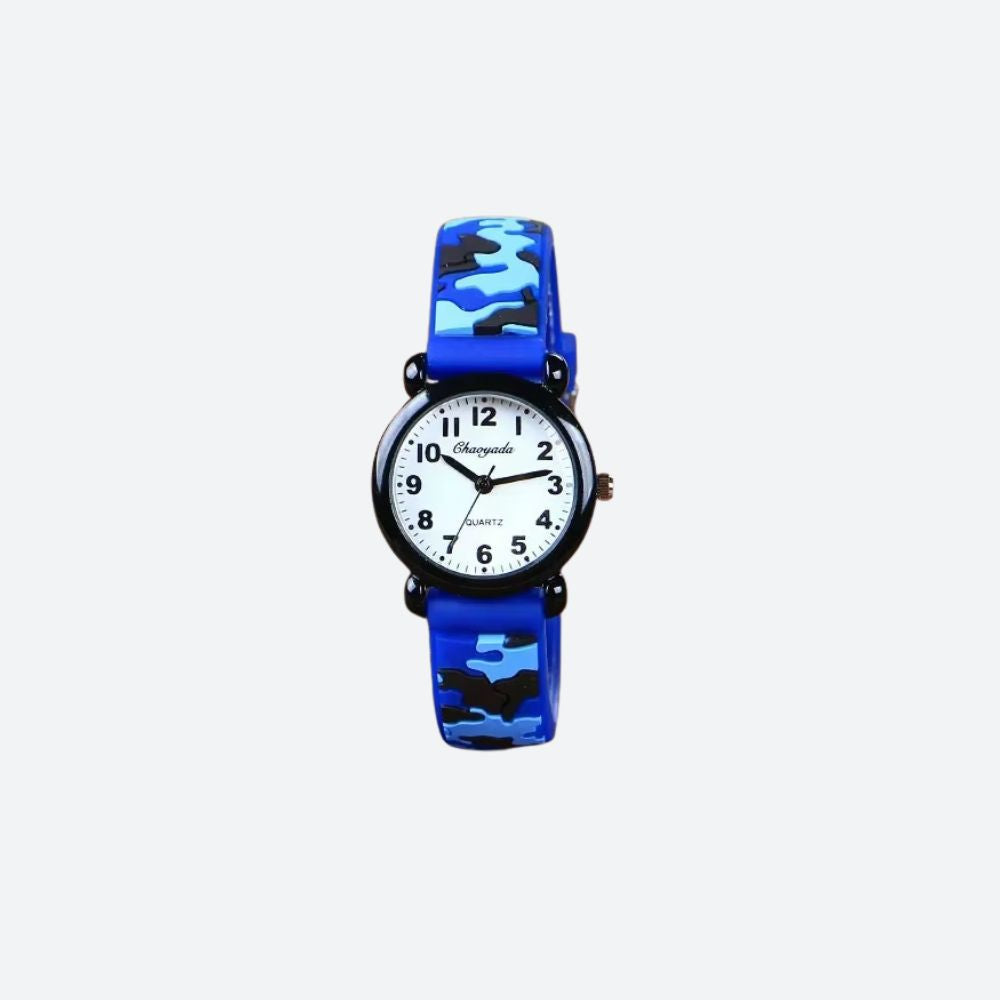
The best watch for kids by age comes down to one question: what does your child actually need the watch to do right now? A three-year-old needs something tough, bright and easy to put on. A six-year-old needs a dial that helps them learn to tell time. An eight- or nine-year-old is ready for a digital watch with alarms and real water resistance. And a GPS smart watch only makes sense once your child starts spending time away from you on a regular basis. This guide walks through each stage, explains what to check before you buy, and ends with a simple method for teaching your child to read an analog watch.
Quick Answer: Which Watch Fits Which Age?
| Age | Best type | What matters most |
|---|---|---|
| 3 to 4 years | Simple analog or fun character watch | Durability, soft strap, bright colors, no small detachable parts |
| 5 to 7 years | Educational analog watch | Labeled minutes, color-coded hands, clear numbers |
| 8 years and up | Digital or sport watch | Water resistance, alarm, stopwatch, backlight |
| Tweens, when needed | GPS smart watch | Battery life, SIM and coverage, parental controls, privacy |
Ages are a starting point, not a rule. Some five-year-olds already read numbers fluently, while some eight-year-olds still benefit from an educational dial. Watch your child, not the calendar.
Ages 3 to 4: Durable, Colorful and Simple
At this age, a watch is mostly a source of pride. Your child will not read the time accurately yet, but wearing a “big kid” accessory builds curiosity about numbers and routines. That means the priorities are practical rather than technical.
What to look for
- A soft, flexible strap. Silicone or fabric bands are comfortable on small wrists and easy to clean. Hook-and-loop closures let toddlers put the watch on by themselves.
- No small parts that come loose. Avoid decorative charms, removable bezels or anything a curious child could pull off and put in their mouth. Check the buckle and the crown, too.
- A sturdy case and lens. Toddlers bump into everything. A plastic or resin case with a scratch-resistant face holds up far better than delicate metal.
- Bright, cheerful design. Animals, camouflage, favorite colors: if your child loves how it looks, they will actually wear it.
- A light weight. Heavy watches end up in a drawer.
If you are shopping for a toddler, browse our selection of watches for 3 year olds, which includes playful options for both boys and girls. Parents looking for a 3 year old girl watch often go for soft pastel straps or animal-shaped cases, while camouflage and bold primary colors are popular with boys. In the end, the best choice is the one your child picks out.
Ages 5 to 7: Learning to Tell Time
This is the golden window for analog watches. Many children start learning about clocks in kindergarten and first grade, and a watch on the wrist turns an abstract lesson into something they practice dozens of times a day. “We leave when the big hand is on the six” becomes a game instead of a negotiation.
Why an educational dial helps
A standard dial shows only the hours, which forces children to work out the minutes in their head. An educational dial does that work visually. Look for these features:
- Minutes printed around the outer ring (5, 10, 15 and so on), so the child can read the long hand directly.
- Color-coded hands, with the hour hand matching the hour numbers and the minute hand matching the minute ring.
- “Past” and “to” sections on some dials, which help children understand phrases like “quarter past” and “ten to.”
- Large, high-contrast numbers that are easy to read at a glance.
Our range of educational kids’ watches is designed with exactly these teaching aids in mind. If you simply want something sized and styled for this age group, see our picks for 5-year-olds as well.
Analog first, digital later
A digital watch seems “easier,” but it shows the time without teaching what it means. An analog face helps children see that half an hour is half the circle and that 3:45 is “almost four.” Once that clicks, switching to digital is effortless.
Ages 8 and Up: Digital Features and Real-World Durability
By around eight, most children can read an analog dial, and their days get busier: sports practice, swimming lessons, after-school clubs. This is when a digital watch starts to earn its place, because its extra functions become genuinely useful.
Features worth paying attention to
- Alarm. Helps with waking up, remembering medication or knowing when screen time is over.
- Stopwatch and timer. Kids love timing races, and a countdown timer is handy for homework sessions.
- Backlight. Makes the screen readable in the dark, at a sleepover or in a dim gym.
- Water resistance. This is the one that causes the most confusion, so read the rating carefully (see below).
- Simple buttons. Too many modes can frustrate younger users. Make sure your child can set the alarm without your help.
Understanding water resistance ratings
Water resistance labels are often misunderstood. A watch marked 30 meters (3 ATM) is generally fine for hand washing and rain, but it is not meant for swimming. For pool time and splashing, look for 50 meters (5 ATM) or more. For regular swimming lessons, 100 meters (10 ATM) gives a more comfortable margin. Whatever the rating, remind your child not to press buttons underwater and to rinse the watch after a trip to the pool or the beach.
You will find sporty, easy-to-use models in our kids’ digital watch collection.
When Does a GPS Smart Watch Make Sense?
Many parents start looking for the best smart watch for kids, or the best kids watches with GPS, for a simple reason: a smart watch can give parents peace of mind without handing a young child a full smartphone. But it is a different category of product, with different trade-offs.
Good reasons to choose one
- Your child walks to school, takes the bus or goes to activities without you.
- You want a way to call or message your child that does not involve a smartphone and social media.
- Your family spends time in busy places (theme parks, festivals, shopping malls) where kids can wander off.
What to check before you buy
- Battery life. GPS and mobile connectivity use a lot of power. Check how long the watch lasts on a typical school day, and plan for nightly charging.
- SIM card and network. Many GPS watches need their own SIM card and data plan to make calls or share location. Confirm which networks the watch supports, whether it needs a nano-SIM or eSIM, and what the plan will cost you each month.
- Location accuracy. GPS works best outdoors. Indoors, many watches rely on Wi-Fi or cell towers, which is less precise. Set realistic expectations.
- Parental controls. Look for an approved-contacts list, a school mode that silences the watch during class, and safe-zone alerts.
- Privacy and data. This is the most important point. Find out what data the companion app collects, where it is stored, and who can access it. Use a strong password on the parent account and keep the app up to date. In the United States, the Children’s Online Privacy Protection Act sets rules for how companies handle data from children under 13, so a clear privacy policy is a good sign.
- School rules. Some schools restrict connected devices. Check before your child shows up wearing one.
If a connected watch fits your family’s needs, take a look at our kids’ smart watches. If the goal is mainly punctuality, a simple analog or digital watch is often the better first step.
How to Teach a Child to Read an Analog Watch
A watch makes practice easy, but a short, structured approach helps the lesson stick. Spread these steps over several days or weeks, moving on only when your child feels confident.
- Start with the hour hand only. Explain that the short hand points to the hour. Practice “o’clock” times first: breakfast at seven, bedtime at eight.
- Introduce the minute hand. Show that the long hand travels all the way around the dial in one hour. Count the minutes in fives around the ring together.
- Learn half past. When the long hand points straight down, the hour is half over. Use a pizza or a pie to show halves visually.
- Add quarter past and quarter to. Divide the dial into four parts and link each quarter to 15 minutes.
- Practice five-minute steps. Read times like 4:25 or 6:40 by counting in fives from the twelve.
- Connect time to daily routines. Ask “What time is it?” at natural moments: before leaving for school, at snack time, at the start of a favorite show. Real-life repetition beats worksheets.
- Celebrate progress. Let your child be the family timekeeper for a day. Responsibility is a powerful motivator.
Practical Tips for Any Age
- Check the fit. You should be able to slide a finger between the strap and the wrist.
- Label it for school with the child’s name on the strap or case back.
- Clean the strap regularly with mild soap and water.
Not sure where to start? Our full range of kids’ watches covers every stage, from first watches for toddlers to sporty models for older children.
Frequently Asked Questions
At what age should a child get their first watch?
Many children enjoy wearing a simple watch from around age three, even before they can read it. The most useful age for a first “real” watch is usually five to seven, when children start learning to tell time at school and an educational analog dial helps them practice every day.
Is an analog or digital watch better for a 5 year old?
For most five-year-olds, analog is the better choice. It teaches how time works as a cycle and supports what they learn in class. A digital watch shows the time, but it does not help children understand it. Digital models become more useful from around eight, when features like alarms and stopwatches matter.
What is the best smart watch for kids?
The best smart watch for kids is one with reliable battery life, a clear SIM and network setup, strong parental controls such as approved contacts and school mode, and a transparent privacy policy. A smart watch is most useful when your child regularly spends time away from you, such as walking to school.
Can kids swim with their watch?
Only if the water resistance rating allows it. A 30-meter (3 ATM) watch handles splashes and rain but is not suitable for swimming. Look for at least 50 meters (5 ATM) for pool play and 100 meters (10 ATM) for regular swimming, and avoid pressing buttons underwater.