
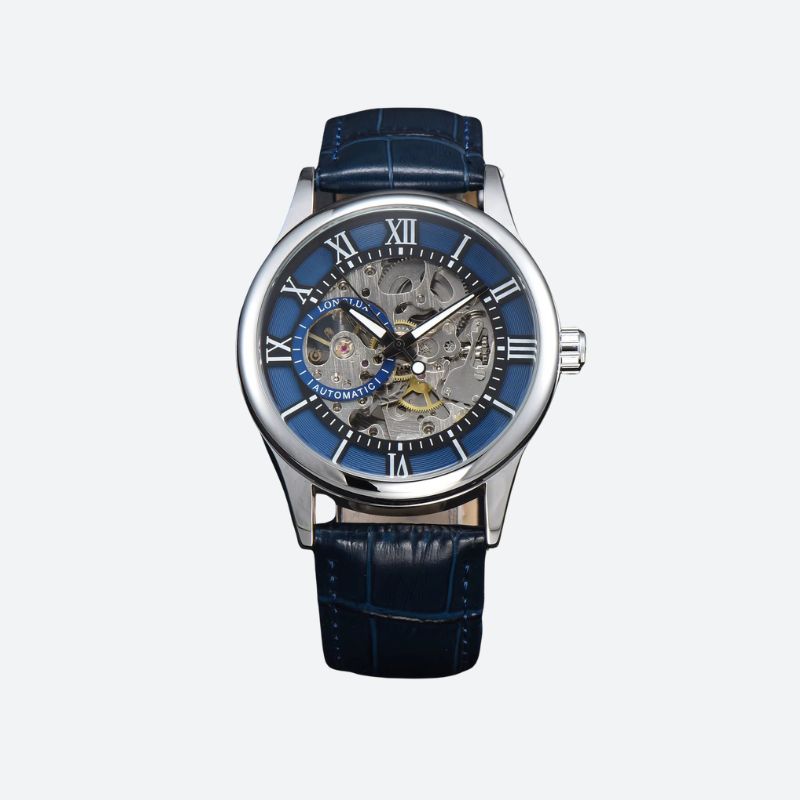
An automatic watch winder is a small motorized cradle that keeps a self-winding watch moving while you are not wearing it, so the mainspring stays wound and the watch keeps running. Do you need one? If you own a single automatic watch and wear it most days, probably not. If you rotate between several automatics, or own a piece with a date, day or moon phase display that is tedious to reset, a winder becomes a genuine convenience. This guide explains how automatic movements store energy, when a winder makes sense, when it does not, and what to check before you buy one.
How an automatic watch stores power
An automatic (self-winding) movement is a mechanical movement with an added rotor: a weighted, half-moon shaped part that pivots freely as your wrist moves. Each swing of the rotor turns a gear train that tightens the mainspring, the coiled spring that releases energy to the escapement and keeps the hands moving. You can read more about the mechanism on the Wikipedia page on automatic watches.
The energy a fully wound mainspring can hold is called the power reserve. Many everyday automatic movements run somewhere around a day and a half to two days once taken off the wrist, while some movements are designed to run longer. Check the specifications of your own watch: the manufacturer usually lists the power reserve, and that number is the single most useful figure when deciding whether a winder is worth it.
When the reserve runs out, the watch simply stops. Nothing breaks. You wind it a few turns through the crown (if the movement allows manual winding), set the time, and it starts again. The question is how often you are willing to do that.
When an automatic watch winder is genuinely useful
You rotate between several automatic watches
This is the most common reason people buy a winder. If you own three or four automatic watches and wear a different one depending on the day or the outfit, each of them will sit idle long enough to stop. A winder keeps the ones you are not wearing ready to put on, set and accurate.
Your watch has complications that are tedious to set
Resetting the time takes seconds. Resetting a date, a day-date, a moon phase or a perpetual calendar can take much longer, and some movements have a window during the night when the date should not be adjusted. If one of your watches has these displays, keeping it running on a winder saves you from repeating that process every time you pick it up.
When you probably do not need one
- You wear one automatic daily. Normal wrist movement keeps the mainspring topped up, and an overnight pause is well within most power reserves.
- Your watches only show the time. A time-only automatic takes a few seconds to set, so a stopped watch is a minor inconvenience.
- You enjoy the ritual. Many owners like hand-winding a watch and setting it in the morning. A winder removes that, which is not an advantage for everyone.
- The watch is stored long term. For a watch you will not wear for months, letting it rest is a reasonable choice. A winder is meant for watches in regular rotation.
A common concern is wear. A winder does keep the movement running, which means the parts are working, exactly as they would on your wrist. Running a watch is what it was designed for, and lubricants are formulated for that use. The practical advice is simply to avoid settings that keep the rotor spinning far more than needed, which brings us to TPD.
Understanding watch winder settings: TPD and rotation direction
Turns per day (TPD)
TPD is the number of full rotations the winder makes in 24 hours. Different movements need different amounts of turning to stay wound, and manufacturers or movement makers often publish a recommended range for their calibers. Most automatic watch winders let you choose between several TPD levels, and they usually rotate in cycles with rest periods rather than spinning continuously, which mimics the irregular movement of a wrist.
If you cannot find the figure for your watch, start with a moderate setting and observe. If the watch stops after a day or two on the winder, increase the TPD. If it keeps running reliably, there is no benefit in going higher. Most modern automatic movements include a slipping clutch that prevents the mainspring from being damaged once it is fully wound, so a slightly higher setting is not harmful, but there is no reason to run the rotor more than necessary.
Rotation direction
Some movements wind when the rotor turns in one direction only, clockwise or counterclockwise, while others wind in both directions. A good winder offers three modes: clockwise, counterclockwise and bidirectional. If you are unsure about your watch, bidirectional is the safe default because it covers both cases, at the cost of needing a somewhat higher TPD to achieve the same winding effect when the movement only winds one way.
Buying checklist: how to choose an automatic watch winder
Once you know you want one, the differences between models come down to a handful of practical points.
| Feature | What to look for | Why it matters |
|---|---|---|
| TPD settings | Several selectable levels | Lets you match each movement instead of using one fixed speed |
| Rotation modes | Clockwise, counterclockwise and bidirectional | Covers movements that wind in one or both directions |
| Number of slots | Single, double or multi-watch | Should match the number of automatics you actually rotate |
| Independent control | Separate settings per slot on multi-watch units | Different watches often need different TPD and direction |
| Motor noise | A quiet motor, especially for a bedroom | A winder runs day and night |
| Magnetic shielding | A shielded or well-isolated motor | Magnetism can make a mechanical watch run fast or erratically |
| Power source | Mains adapter, batteries or both | Affects where you can place it and how often you maintain it |
| Watch pillow | Adjustable cushion that holds the strap securely | Fits different wrist sizes, bracelets and leather straps |
Single vs multiple slots
Count the automatic watches you wear in rotation, not every watch you own. A quartz watch does not need a winder, and a manual-wind watch cannot be wound by one. If you own two automatics today but are building a collection, a model with an extra slot gives you room to grow. If each slot has its own settings, you can run a one-direction movement and a bidirectional movement side by side without compromise.
Motor noise
Because the winder runs around the clock, noise matters more than it seems in a store. If it will sit in a bedroom or a quiet office, look for a model described as having a quiet or low-noise motor, and favor units with rest cycles, since the pauses also reduce how often you hear the motor at all.
Magnetic shielding
Electric motors produce a small magnetic field. A mechanical movement exposed to magnetism can become magnetized, which typically makes it run fast. Better winders isolate or shield the motor from the watch cradle. If a watch starts gaining time noticeably after weeks on any winder, a watchmaker can demagnetize it quickly.
Power source
Mains-powered winders are the most convenient for permanent placement on a shelf or dresser. Battery-powered models can go anywhere, including inside a closet or a safe, but you will need to replace or recharge the batteries. Many units accept both, which is the most flexible option.
Storage and presentation
A winder is also a display piece. Think about where it will sit and how it fits with the rest of your setup. Many collectors keep the automatics in rotation on a winder and store everything else, including quartz and dress pieces, in one of the watch boxes and cases designed to protect crystals and straps.
Setting up your winder in a few steps
- If the watch has stopped, give it a few turns through the crown (when the movement allows manual winding) so it starts with some reserve.
- Set the time, and the date or other complications if needed.
- Fasten the strap or bracelet around the pillow and place it in the cradle so it sits firmly.
- Choose the rotation direction recommended for your movement, or bidirectional if you are unsure.
- Select a moderate TPD, then check after a few days whether the watch is still running and accurate.
- Adjust the TPD up or down based on what you observe.
Choosing the right setup for your collection
If you are starting out, one well-made automatic worn often is more rewarding than several sitting idle. A skeleton model such as this men’s automatic leather skeleton watch lets you see the rotor and balance wheel at work, which is a good way to understand exactly what a winder is doing for you. When your rotation grows, browse our selection of men’s automatic watches, then pick a unit from our range of automatic watch winders with the number of slots that fits. For straps, pouches and other care items, see our watch accessories.
FAQ
Is it bad to leave an automatic watch on a winder all the time?
Not if the winder is set correctly. Running continuously is what the watch would do on your wrist. Use a TPD level that keeps it running without excess, choose the right rotation direction, and have the watch serviced at the intervals the manufacturer recommends, as you would anyway.
How many turns per day does my automatic watch need?
It depends on the movement. Look for the recommended TPD in your watch’s documentation or the caliber’s published specifications. If none is available, start at a moderate setting and increase it only if the watch stops while on the winder.
Can a watch winder overwind my watch?
Most modern automatic movements use a slipping mainspring or clutch that stops the spring from being tightened beyond its limit, so a winder cannot overwind it in the damaging sense. Excessive turning only adds unnecessary activity, which is why matching the TPD is still worthwhile.
Do I need a watch winder for a quartz or manual-wind watch?
No. A quartz watch runs on a battery, and a manual-wind watch has no rotor, so turning it in a winder does nothing. Winders are only useful for automatic, self-winding movements.
What is the difference between automatic winders and unwinders?
There is no separate product called an unwinder. The word usually appears as a misspelling of winder in searches and listings, or loosely to describe the rest phase of a winder’s cycle, when the rotor stops turning. What matters is that the device lets you set TPD and rotation direction for your automatic watch.